Suicide is a huge issue that is extremely stigmatized and ignored. It ranks among the 10 leading causes of death in most Western countries - and the number of suicides is likely higher than estimated since many deaths are ruled "accidental" rather than being given the stigmatized label of "suicide."
Showing posts with label Mental Health. Show all posts
Friday, December 11, 2015
Friday, November 27, 2015
Dialectical Behavioral Therapy
Thursday, November 19, 2015
Crazy: A Father's Search Through America's Mental Health Madness, by Pete Earley
![]() |
| Crazy: A Father's Search Through America's Mental Health Madness, by Pete Earley, Narrated by Michael Prichard |
When Pete Earley's son was diagnosed with schizophrenia Earley was devestated. His son's potential career was on the line, he wasn't willing to accept treatment, and he was generally unpredictable and very unsafe. When Earley tried to get his son into the hospital, his son was turned away because he didn't want to be treated - and laws say that unless someone is an immediate threat to himself or others, he can not be treated involuntarily. Earley had to pretend his son was a threat to Earley's well-being to get his son hospitalized. Then Earley went to a commitment hearing to make sure his son stayed in the hospital until he was better. Early was appalled by his son's defense lawyer who did her best to defend Earley's son despite his son's clear mental illness. In her own defense, the lawyer said it was her job to defend the rights of someone who did not want to be committed. Earley's son won the case and was released.
Wednesday, November 18, 2015
Stress and Your Body: An introduction
![]() |
| Great Courses: Stress and Your Body, by Professor Robert Saplosky, narrated by Robert Saplosky |
Robert Saplosky is a professor of biological sciences, neurology, and neurosurgery at Stanford University. His lab focuses on how stress affects the nervous system. He also has extensive field work, studying a particular population of wild baboons in East Africa - where he examines how social rank, personality, and sociality affect vulnerability to stress-related disease. He is a fantastic lecturer, and if you get the chance to watch a YouTube video of him lecturing, go for it.
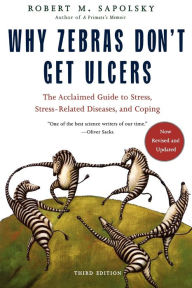
Saplosky and The Teaching Company developed the course Stress and Your Body to teach us about the detrimental effects of stress on our health. The primary textbook is his own Why Don't Zebras Get Ulcers? Which, as far as I can tell from chapter 1 versus lecture 1, is pretty much verbatim with his lectures.
Sunday, November 15, 2015
The Biological Effects of Anxiety on the Body
Stress and anxiety can wreak havoc upon your body. It can lead to problems with childhood physical development, and affect the immune, endocrine, gastrointestinal, and cardiovascular systems. It can exacerbate diabetes. Stress affects the mind as well, a tragic example being PTSD, where an individual might relive a traumatic event over and over.
Stress can be either good or bad event - such as marriage or a divorce. Low levels of stress can actually be a good thing - for instance, a small amount of stress might help you prepare for an upcoming exam better than you otherwise would have. But sometimes stress becomes overwhelming, and biological systems in your body that would usually only slightly increase during "good stress," go into overdrive - potentially on a long-term basis.
Saturday, November 7, 2015
Personality Disorders - Cluster A
As mentioned in my opening post about personality disorders, personality disorders are split into three clusters: A, B, and C. This post will discuss the cluster A personality disorders. Cluster A disorders are characterized by distrust, suspiciousness, and social detachment. Often, people with cluster A personality disorders are considered eccentric or odd.
Wednesday, November 4, 2015
Personality Disorders - Clusters and Dimensions
Personality disorders are a difficult topic for me. For one thing, they are highly stigmatized. And I think the term "personality disorder" encourages that stigma by suggesting that there is something terribly wrong with a person's identity, rather than implying that people with these disorders respond to the world in a highly ineffective manner that creates problems for themselves and others. In fact, Butcher describes "personality disorder" in his textbook Abnormal Psychology as: characterized by "chronic interpersonal difficulties and problems with one's identity or sense of self." This description is good as long as we accept that the "problem with one's identity" is that one's self-esteem and view of one's relationships with others is unstable.
Tuesday, November 3, 2015
The Noonday Demon, by Andrew Solomon
![]() |
| The Noonday Demon: An Atlas of Depression, by Andrew Solomon, narrated by Barrett Whitener |
Noonday Demon is Andrew Solomon's amazing memoir / history of depression - it's a must-read for anyone who wants to delve deeply into the causes and effects of depression. Solomon begins with his own journey through several severe depressive episodes. For a broader personal understanding of depression, he intermittently includes stories of "depressives" that he's interviewed. In his research for this book, Solomon explored many standard therapies for depression (i.e. medicine, psychotherapy, cognitive behavioral therapy, electroconvulsive therapy, etc.); but he also explored some very atypical therapies such as an African ritual in which he lay naked and covered in goat blood while people danced around him with a dead chicken. (He actually found it very cathartic.)
Sunday, November 1, 2015
Depression - an overview
Depression is a surprisingly common mental health issue, affecting 17% of Americans at some point throughout their lifetimes. Depressions almost always are a result of a stressful life event, though not all of these depressions are severe enough or long enough in duration to be considered a mood disorder.
Tuesday, October 20, 2015
Post Traumatic Stress Syndrome - the Basics
I think we all have some idea of what we think PTSD is, but it turns out PTSD isn't as clear-cut as I thought.
Apparently, when PTSD was first introduced into the DSM, the diagnostic criteria required a traumatic event "outside the range of usual human experience" that would cause "significant symptoms of distress in almost anyone." That fits pretty well with my own perception of PTSD. Rape, war, torture, violent experiences...these all fit into that description. PTSD is a normal response to an abnormal stressor.
Thursday, October 15, 2015
Clinical Mental Health Diagnosis - Psychological Assessment
In my post about the biological assessment of mental health diagnosis, I mentioned that there are three ways a clinician can focus a mental health assessment: biological, psychodynamic, and behavioral. In this post I will discuss the psychodynamic and behavioral assessments of patients.
I'm not sure what a psychological assessment feels like to the clinician, but I have been through several assessments as a patient. Some of them have been very grueling and embarrassing - my 2 hour long assessment for dialectical behavioral therapy comes to mind. Generally, the mental health worker will ask a series of questions to determine personality (am I maladaptive?), social context (am I from an abusive family? caring for an sick family member? a bullied teen?), and culture (I'm a WASC) .
Wednesday, October 14, 2015
Clinical Mental Health Diagnosis - Biological Assessment
One of the most difficult tasks for mental health workers is to clinically assess and diagnose mental illnesses - especially when comorbidity (having more than one mental illness) is so common. It usually begins with a psychological assessment through tests, observation, and interviews so the clinician can catalog the symptoms. Then the DSM-5 is consulted to give the diagnosis.
A clinician may focus the assessment in three ways - biological, psychodynamic, and behaviorally.
Subscribe to:
Posts (Atom)